
Showing posts with label israel. Show all posts
Showing posts with label israel. Show all posts
Friday, January 30, 2009

Tuesday, January 13, 2009
Oil falls below $37

Oil prices fell below $37 a barrel Tuesday in Asia on expectations crude demand will weaken amid a severe global economic slowdown.
Light, sweet crude for February delivery was down 92 cents at $36.67 a barrel by afternoon in Singapore in electronic trading on the New York Mercantile Exchange
Crude prices have fallen more than 25 percent since reaching just above $50 a barrel last week as traders returned from the holiday break to find evidence of falling manufacturing and consumer spending across the globe.
The February contract fell 8 percent on Monday, or $3.24, to settle at $37.59 after Alcoa Inc., the world's third-largest aluminum company, reported a quarterly loss of $1.19 billion.
Alcoa, the first component of the Dow Jones industrial average to post results, said last week it plans to lay off about 13 percent of its global work force by the end of 2009 amid sinking prices and demand for the metal.
The Dow fell 1.5 percent Monday and has dropped 3.5 percent this year.
"The negative sentiment we're seeing reflects the broad international macroeconomic outlook, which is considerably weaker, and what that means for energy consumption," said David Moore, commodity strategist at Commonwealth Bank of Australia in Sydney.
Prices have fallen despite continued fighting between Israel and Hamas in Gaza. Israeli troops advanced into Gaza suburbs for the first time Tuesday, after Prime Minister Ehud Olmert warned Islamic militants of an "iron fist" unless they agree to Israel's terms to end the fighting. About 900 Palestinians and 13 Israelis have died since the conflict started on Dec. 27.
After initially spurring a jump in oil prices, the Gaza conflict has been largely ignored by traders because it hasn't affected major supplies and no oil-rich Middle East neighbors have become directly involved.
"The impact on oil supply is obviously limited," Moore said.
Prices of futures contracts for later this year are higher than the February contract on investor expectations that announced production cuts of 4.2 million barrels a day since September by the Organization of Petroleum Exporting Countries will begin to reduce global supply.
The June contract trades at $50.40 a barrel.
"There's some wariness that the OPEC actions may cause markets to tighten up," said Moore, who expects oil to average $55 a barrel this year.
Investors are also looking for signs that demand from emerging markets, which helped drive oil's rise to $147.27 a barrel in July, will rebound.
"Growth concerns will dominate for the next few months," said Robert Prior-Wandesforde, co-head of Asian economic research at HSBC in Singapore. "Commodity prices will start to improve as sentiment about China and India starts to turn later this year."
In other Nymex trading, gasoline futures fell 0.41 cent to $1.08 a gallon. Heating oil dropped 0.24 cent to $1.47 a gallon while natural gas for February delivery slid 1.4 cents to $5.53 per 1,000 cubic feet.
Sunday, January 11, 2009
Israeli Attacks Gaza
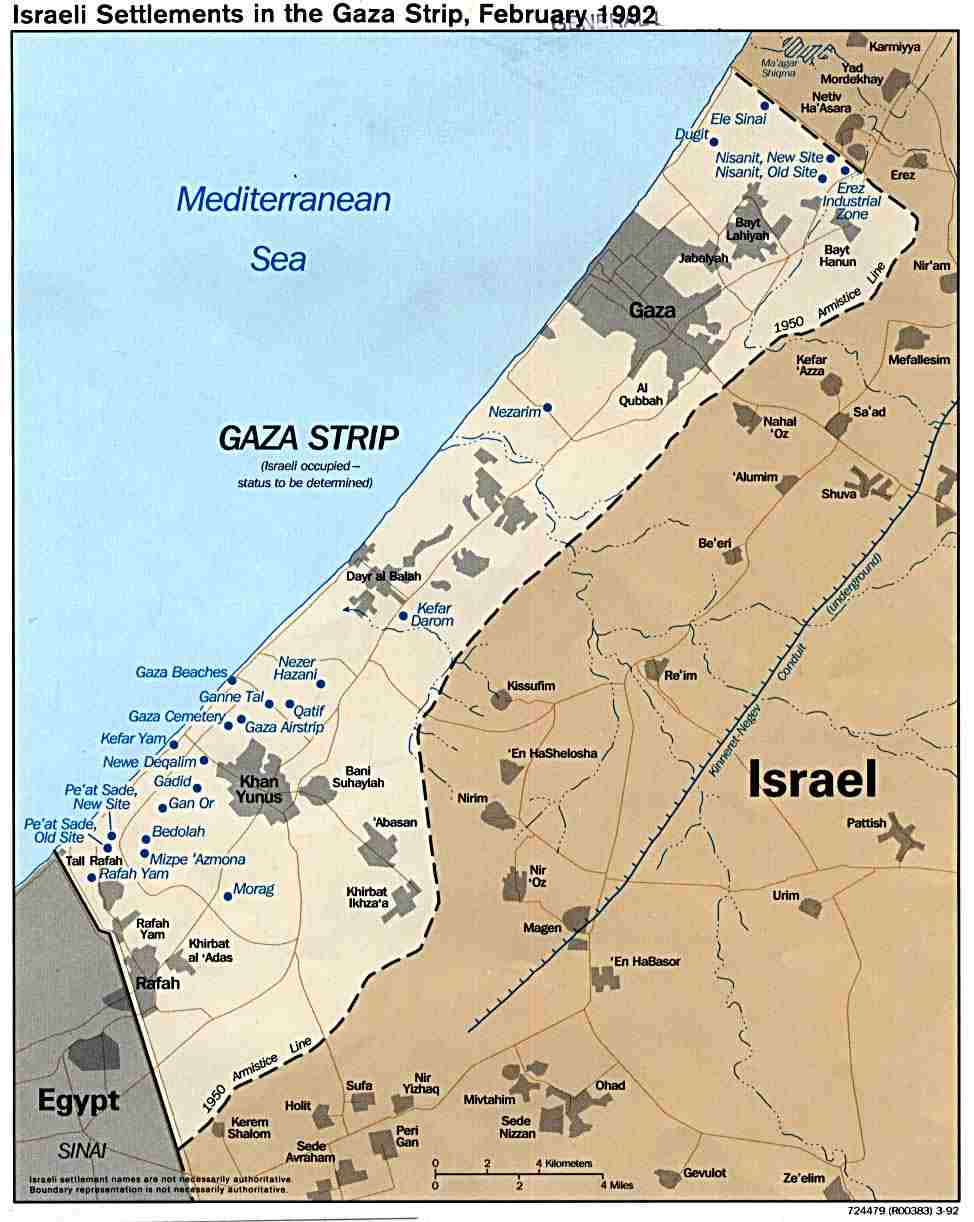
Late Saturday morning 80 Israeli fighter planes and Apache helicopters launched the first wave of several air attacks over the Gaza strip. Dozens of sorties dropped over a hundred bombs on 150 Hamas targets, destroying 40, including police stations and military installations in a matter of minutes.
Early Sunday morning a second wave of Israeli military strikes bombed a mosque and the Hamas-run Al-Aqsa TV station.
Simultaneously, the Israeli Defence Forces (IDF) amassed hundreds of infantry and armoured corps troops on the Gaza border in preparation for a possible ground invasion.
Israeli Defence Minister Ehud Barak rejected calls by the UN and the EU for a ceasefire, and told the international media that Israel would not rule out widening the offensive to include a ground operation.
"For us to be asked to have a ceasefire with Hamas is like asking you to have a ceasefire with Al-Qaeda," Barak said in an interview with Fox News.
It's something we cannot really accept. Our intention is to totally change the rules of the game," he added.
Most of those killed and wounded were Hamas military and police personnel. However, dozens of Palestinian civilians are reported to be among the dead.
The civilian casualties are expected to rise. Many of Hamas's installations are in densely populated civilian neighbourhoods. School children in several surrounding schools were on their way home as the first wave of bombs hit Gaza city.
Grim scenes of carnage fill the corridors of Gaza's hospitals and morgues as the dead and dying, and mutilated bodies lie on the ground due to a shortage of hospital beds and morgue space.
Medical staff are treating the wounded under severe pressure, as Gaza has limited supplies of electricity, medicine, medical equipment, and fuel to operate emergency generators due to the Israeli-imposed blockade of the coastal territory. Only very limited amounts of humanitarian aid is allowed in.
Egypt, in a rare display of solidarity with the beleaguered Gazans, has opened its Rafah border crossing to allow the wounded to be evacuated to Sinai hospitals to receive medical treatment.
"It is madness and people are in a state of shock," Elena Eqleibo, a former Costa Rican diplomat and hardened aid worker who has lived in Gaza city for several years told IPS.
"I had just finished a meeting in the municipality when suddenly there were massive booms and plumes of smoke surrounding the entire area," said Eqleibo, whose apartment is located near a major Hamas headquarters.
"I visited some neighbours at the local supermarket and grocery store, and everybody is in a state of shock. Nobody can believe the scale of the attack.
" Abdallah Al-Agha, who lives near the former presidential palace of the late president Yasser Arafat, which was then taken over by Hamas and subsequently targeted by the Israelis, said there were scenes of chaos outside his apartment when the first bombs hit.
"The thunderous explosions went on for what seemed ages. People were panicking, ambulances and fire trucks were tearing down the streets and trying to help the wounded and put out fires which had broken out amongst the crumbled buildings. "Children were screaming and crying and mothers were hysterically looking for their kids coming home from school," Agha told IPS.
Israel had been threatening a large-scale military incursion following an increasing number of rockets fired by Palestinian resistance groups at Israeli towns bordering Gaza.
The rocket attacks followed the end of a fragile six-month ceasefire between Israel and Hamas and ten days of intensive fighting last month following an Israeli cross-border military incursion into Gaza.
The Islamic resistance organisation accused Israel of breaching the terms of the truce by refusing to lift the hermetic sealing of Gaza's borders.
But the timing of Israel's attacks caught Hamas by surprise. Israel had temporarily opened the borders for a few hours on Friday to allow in several convoys of humanitarian aid.
This was done as the Israeli government simultaneously launched a massive diplomatic campaign to explain its case for a military operation to the international community.
Israeli intelligence timed the operation to coincide with a meeting of Hamas's leadership, several of whom were killed, as well as a graduation ceremony of hundreds of new Hamas police cadets.
But the Israelis are aware that the attacks will not cow Hamas, and that retaliatory rocket fire can now plague Israeli border towns on an even larger scale.
Following the initial Israeli sorties, Hamas and smaller resistance groups rained rockets down on Sderot, Ashkelon and other border towns, killing an Israeli and wounding others.
Israel has declared a state of emergency. Israelis within a 10-kilometre radius of Gaza were ordered to enter bomb shelters within 15 seconds of a siren warning.
Residents within a 20-30 kilometre radius were ordered to enter shelters within 45 seconds of siren warnings.
Meanwhile, the IDF is expecting an increased daily rocket barrage of up to 100 missiles, some of which are expected to reach cities and towns located further away as Hamas uses upgraded projectiles with a 40-kilometre range as opposed to the current range of only 20 kilometres.
Analysts on both sides of the Israeli-Palestinian divide are arguing that the current military invasion is not about deterrence but more about the upcoming Israeli elections in February where Barak is a candidate for the prime minister's seat.
Tuesday, March 11, 2008
Yahoo research centre in Israel
 Web search company Yahoo Inc.said on Tuesday it has launched a new research lab in Israel, its first in the region.
The research lab in the northern port city of Haifa will be led by Ronny Lempel, an information organisation and retrieval expert. He previously worked at the Information Retrieval Group at IBM's Haifa Research Lab, focusing on research and development for enterprise search systems.
The lab, which opened on Tuesday, will focus on simplifying complex technology problems in searching the Web, Yahoo said.
Rival Google opened its second R&D centre in Israel in June. Its Israeli centres are in Tel Aviv, Israel's financial and cultural centre, and Haifa.
"Search is still in its infancy," Prabhakar Raghavan, head of Yahoo Research, said in a statement. "At Yahoo, we are working on the hard core science that can lead to search experiences that are significantly beyond the current art." (Reporting by Tova Cohen, editing by Elizabeth Fullerton)
Subscribe to:
Posts (Atom)


